




Why Are Folding Houses Suitable for Emergency Housing?
2026-02-05 03:39:39
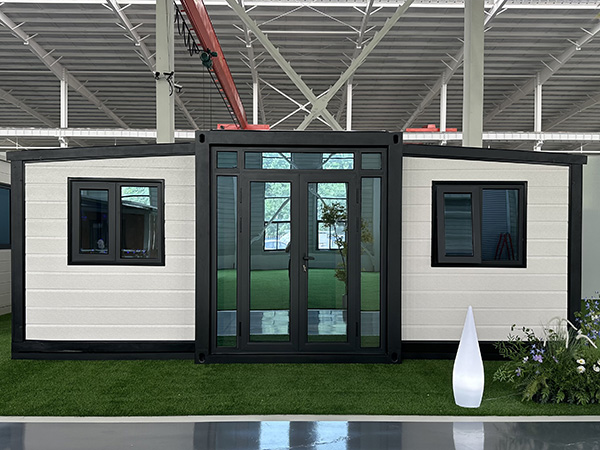
Why Are Folding Houses Suitable for Emergency Housing?
Folding houses are uniquely tailored to the core demands of emergency housing scenarios—rapid deployment,flexible mobility,simple implementation,and basic livability—addressing the urgent space needs of disaster relief,sudden resettlement,and emergency rescue where time is critical,sites are unpredictable,and professional resources are often limited.Unlike traditional buildings,modular houses,or temporary shacks,their design and performance perfectly align with the special requirements of emergency response,making them the optimal choice for emergency housing solutions.Below is a detailed analysis of their core suitability,centered on the key pain points of emergency scenarios:
1.Ultra-fast deployment to meet the urgent time demand of emergencies
Emergencies such as natural disasters(earthquakes,floods,typhoons)and sudden public incidents require immediate housing support for affected people or rescue personnel,and folding houses realize"immediate arrival and immediate use"with their simplified installation process:
No complex on-site construction,only 2–3 ordinary staff are needed to complete the whole unfolding and locking process in 30 minutes to a few hours with basic hand tools,far faster than modular houses(which need splicing and hoisting)or temporary tent houses(which need complex frame building and covering).
The whole product is factory prefabricated with integrated basic functions(waterproofing,thermal insulation,lighting);there is no need for on-site secondary assembly of functional components,and it can be put into use immediately after unfolding and locking,effectively shortening the waiting time for emergency shelter.
2.No special transportation/site requirements,adaptable to complex emergency sites
Emergency sites are often with harsh conditions:remote locations,damaged road infrastructure,uneven ground,and lack of professional construction equipment and flat construction sites.Folding houses break through these limitations with their compact and lightweight design:
Easy transportation:Folded into a compact volume(1/5–1/10 of the unfolded size)and light in weight(most small and medium models are only a few hundred kg to 3 tons),they can be transported by ordinary light trucks,pickup trucks,or even off-road vehicles,and can reach remote disaster-stricken areas where large transport vehicles and hoisting equipment are inaccessible;bulk transportation can also stack folded units to save space and improve transport efficiency.
Zero strict site requirements:Only a flat,debris-free ground is needed for installation(a small slope of≤3°is acceptable),and no fixed foundation construction(e.g.,concrete pouring,ground hardening)is required—even on temporary open spaces in disaster areas,damaged urban roadsides,or mountainous open areas,simple cushioning materials(wooden boards,steel plates)can be laid for quick installation,perfectly adapting to the complex and changeable site conditions of emergencies.
3.Lightweight but with guaranteed basic livability and safety
Emergency housing needs to ensure the basic living safety and comfort of occupants in harsh environments,and folding houses balance lightweight design with practical performance,avoiding the defects of poor windproof,waterproof and thermal insulation of simple tent houses:
Structural stability for emergency environments:The unfolded structure forms a rigid support system through scissor-type telescopic braces,multi-point self-locking mechanisms and triangular stress structures,which can resist light to moderate winds(≤6 grades)and rain—far more stable than tent houses,and can effectively protect occupants from secondary damage caused by bad weather after disasters.
Integrated basic protective performance:The composite panels used in production are pre-processed with fireproof,waterproof,thermal insulation and anti-UV functions,and the panel joints are sealed with high-density rubber strips;even in cold,rainy or hot outdoor emergency environments,it can provide a closed and relatively comfortable living space,avoiding the problems of heat loss,water seepage and sun exposure of simple temporary housing.
Basic safety configuration:Manufacturers can pre-install simple fire-fighting equipment(fire extinguishers),smoke detectors and unobstructed emergency exits according to emergency needs,and the internal wiring complies with electrical safety standards,eliminating fire and electric shock hazards in the use process.
4.High flexibility and reusability,adapting to the dynamic changes of emergency scenarios
Emergency response is a dynamic process:the scope of disaster-affected areas may expand,rescue personnel need to transfer with the rescue front,and the demand for temporary housing may move to different sites at any time.Folding houses have strong mobility and reusability to match this dynamic demand:
Quick relocation and secondary deployment:The installation process is fully reversible—unlocking the fasteners,folding the frame and panels in reverse order can complete the disassembly in a short time,and then transport to new emergency sites for redeployment without structural damage;this is far more flexible than modular or container houses,which are difficult to disassemble and relocate.
Repeated use for multiple emergencies:Made of wear-resistant and corrosion-resistant lightweight materials(aluminum alloy/light steel frames,industrial-grade hardware),folding houses can withstand dozens of repeated folding and unfolding operations with simple maintenance(lubricating hinges,tightening fasteners);they can be stored in a compact state after the end of one emergency,and quickly taken out for use when other emergencies occur,realizing the recycling of emergency resources and reducing the cost of emergency material reserves.
5.Low comprehensive cost and easy large-scale reserve&deployment
Emergency relief requires large-scale temporary housing support in a short time,and the government and rescue organizations have strict requirements on the cost and reserve efficiency of emergency materials.Folding houses have obvious cost advantages in production,transportation,storage and use:
Low production and transportation costs:The structure is simple,the materials are standardized and lightweight,and the production cost is far lower than modular and container houses;no special transport vehicles and equipment are needed,which greatly saves the large-scale transportation cost of emergency materials.
Space-saving storage:Folded folding houses can be stacked in a small warehouse(a single standard warehouse can store dozens of small and medium models),with no need for a large dedicated storage space—this is crucial for the daily reserve of emergency materials,as it can save storage costs and realize the centralized and efficient reserve of a large number of emergency housing units.
Zero post-use disposal cost:Unlike disposable temporary shacks that generate a lot of construction waste after use,folding houses can be recycled and stored for secondary use after the emergency is over,avoiding resource waste and environmental pollution,and conforming to the concept of green emergency relief.
6.Simple operation and maintenance,no reliance on professional teams
In emergency scenarios,professional construction and maintenance personnel are often scarce,and most of the on-site staff are rescue volunteers,government staff or affected people with no professional construction experience.Folding houses are designed for non-professional operation:
The installation,disassembly and folding operations follow a simple"unfold-lock-use"and"unlock-fold-reload"logic,with clear illustrated operation manuals and video tutorials provided by manufacturers;even people with no relevant experience can master the operation in a short time with simple guidance.
Daily maintenance only requires simple work such as lubricating the hinge joints,tightening loose fasteners and replacing damaged sealing strips,without professional tools and skills;on-site staff can complete the maintenance independently,ensuring the normal use of the house in the long-term emergency resettlement process.
Core Summary
Folding houses solve the core pain points of emergency housing scenarios—urgency of time,complexity of sites,dynamics of demand,and scarcity of professional resources—with their unique advantages of rapid deployment,strong site adaptability,guaranteed basic livability,high mobility and low cost.They are a fast,practical,flexible and cost-effective emergency housing solution,filling the gap between simple tent houses(poor performance)and modular/container houses(slow deployment,high cost,harsh site requirements)in emergency response,and have become an important part of the emergency material reserve system in various countries and regions.
References
GB/T 7714:Pérez-Valcárcel J, Muñoz-Vidal M, López-César I, et al. Deployable temporary housing for emergencies[J]. The Journal of Architecture, 2024, 29(7-8): 1157-1184.
MLA:Pérez-Valcárcel, J., Muñoz-Vidal, M., López-César, I., Muñiz Gómez, S., Suárez-Riestra, F., Freire-Tellado, M. J., ... & Mosquera-Rey, E. (2024). Deployable temporary housing for emergencies. The Journal of Architecture, 29(7-8), 1157-1184.