




How Are Folding Houses Manufactured?
2026-02-05 02:47:13
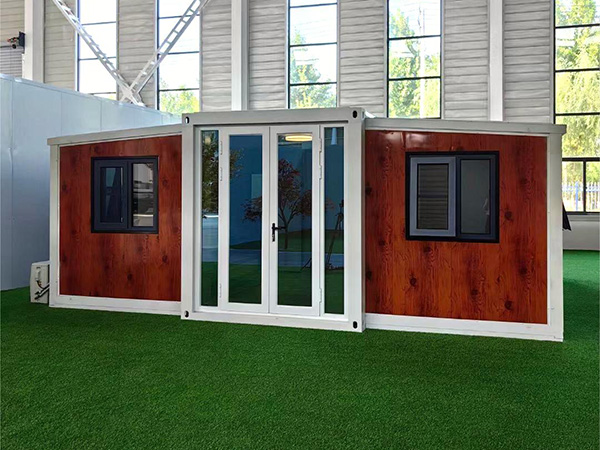
Folding house production is a streamlined industrial manufacturing process combining light steel structure processing,composite panel production,and precision hardware assembly,all completed in a factory with standardized workflows.The whole manufacturing process focuses on structural precision(to ensure smooth folding/unfolding)and material durability(to match repeated use),and the finished products are fully prefabricated—only on-site unfolding and locking are needed after delivery.Below is the complete standardized manufacturing process for mainstream folding houses(aluminum alloy/light steel frame type):
1.Pre-Production:Design&Material Sourcing&Cutting
Design Optimization&Parameter Calibration
First,conduct structural design and simulation according to the product’s unfolded size,folding ratio,and load-bearing requirements(e.g.,wind resistance,daily use load).Key parameters such as hinge installation position,scissor brace telescopic stroke,and lock matching precision are calibrated via 3D modeling to ensure no jamming during folding/unfolding.The design also integrates functional requirements like waterproofing,thermal insulation,and basic wiring pre-burial.
Sourcing of Core Raw Materials
Select high-quality,lightweight,and durable materials matching the design:
Frame materials:High-strength aluminum alloy profiles(6061/6063)or cold-formed light steel keels(Q235B),with corrosion resistance treatment for outdoor use;
Panel materials:Fireproof and thermal insulation composite panels(e.g.,EPS/XPS foam core+color steel plate/glass magnesium plate),with waterproof and anti-UV coating on the surface;
Hardware accessories:Industrial-grade heavy-duty hinges,self-locking scissor telescopic braces,spring snap locks,bolt fasteners,rubber sealing strips,and retractable support legs;
Auxiliary materials:Anti-rust paint,structural adhesive,insulation cotton,pre-buried wire tubes,and simple functional components(lighting sockets,ventilation fans).
Precision Cutting&Forming
Cut frame profiles(aluminum alloy/light steel)and composite panels into fixed sizes using CNC cutting machines and shearing machines,with strict tolerance control(±0.5mm)to avoid assembly errors.Bend the frame profiles into required shapes(e.g.,corner brackets,support frames)via bending machines,and punch mounting holes(for hinges,locks,braces)on the frames with CNC punching machines—ensuring all holes are aligned for subsequent assembly.
2.Core Production:Frame Processing&Panel Pre-Assembly
Frame Surface Treatment&Reinforcement
Conduct anti-corrosion and anti-rust treatment on light steel frames:pickling,phosphating,and electrostatic spraying(powder coating)to enhance outdoor service life;
Anodize aluminum alloy frames to improve wear resistance and corrosion resistance;
Weld or bolt reinforce key load-bearing parts of the frame(e.g.,bottom support,roof beam)to ensure structural rigidity after unfolding.
Composite Panel Pre-Fabrication
Process the cut composite panels into finished wall,roof,and floor panels:
Install edge sealing strips on the panel edges to prevent core material aging and water seepage;
Pre-embed door and window openings on the wall panels according to the design,and install frame buckles for quick connection with the main frame;
For panels with built-in functions,pre-bury wire tubes and junction boxes in the panel interlayer to avoid on-site wiring.
3.Key Step:Integrated Assembly&Folding Performance Debugging
This is the most critical link in manufacturing,directly determining the smoothness of folding and structural stability,and is completed on a dedicated assembly line by professional technicians.
1.Primary Frame Assembly
Splice and fix the processed main and secondary frames(bottom,wall,roof)with high-strength bolts to form the basic foldable frame skeleton,and install retractable support legs at the bottom of the frame.
2.Hardware&Panel Connection
Install industrial-grade heavy-duty hinges at the preset rotation joints of the frame(wall-wall,wall-roof,wall-floor)to ensure flexible rotation and stable load-bearing;
Embed scissor-type telescopic braces between the inner sides of the frames,and connect the braces to the frame with rotating shafts—ensuring the braces stretch/retract synchronously with frame folding/unfolding;
Fix the prefabricated composite panels(wall,roof,floor)to the frame skeleton with buckles and structural adhesive,and reserve gaps for sealing strips between panels;
Install self-locking mechanisms(spring snap locks,bolt fasteners)at key positions(hinge joints,brace ends)to lock the structure after full unfolding.
3.Folding&Unfolding Performance Debugging
Repeated debugging(≥10 times)is required for each assembled folding house unit to eliminate jamming and misalignment:
Manually fold and unfold the unit to check if the frame and panels move synchronously,and adjust the hinge position and brace stroke if jamming occurs;
Test the locking mechanism to ensure all locks can be fully engaged/disengaged,and the locked structure has no looseness or shaking;
Check the parallelism and levelness of the unfolded frame to ensure the house is stable in use.
4.Functional Fitting&Sealing Treatment
Pre-Installation of Internal Functional Components
Install all pre-configured functional parts in the factory to realize factory-integrated completion and avoid on-site assembly:
Connect the pre-buried wire tubes with lighting sockets,switches,and ventilation fans,and arrange the wires in a hidden way(in the frame/panel interlayer);
Install door and window sashes on the pre-embedded door/window openings,and equip with handles,latches,and sealing rubber strips;
Lay anti-slip floor mats on the floor panels(if needed),and install simple internal partitions(customized models).
Full Sealing&Waterproofing Processing
Strengthen the waterproof and windproof performance of the whole house,the key to adapting to outdoor use:
Paste high-density rubber sealing strips at all panel joints,frame gaps,and door/window edges,and fix them with structural adhesive to prevent water seepage and air leakage;
Apply waterproof sealant at the welding/bolting positions of the frame to enhance anti-corrosion and waterproofing;
Install waterproof eaves on the roof edge(if needed)to guide rainwater flow and avoid water accumulation.
5.Final Inspection&Packaging&Delivery
Factory Final Quality Inspection(QI)
Carry out a comprehensive performance test on each finished folding house unit,and only deliver qualified products:
Check the appearance:no obvious scratches,deformation,or paint peeling on the frame and panels;
Re-test folding/unfolding and locking performance:ensure smooth operation and stable locking;
Conduct waterproof and airtightness tests:spray water on the roof and walls to check for no water seepage;
Test functional components:verify normal operation of lighting,sockets,ventilation fans,and flexible opening/closing of doors/windows;
Inspect the overall load-bearing capacity:conduct light load tests on the floor and roof to ensure no deformation.
Standardized Packaging for Transportation
Fold the qualified finished product into a compact state,and perform protective packaging to avoid damage during transportation:
Lock all transport buckles and straps to fix the folded frame and prevent loosening during transportation;
Cover the surface of the house with anti-scratch and waterproof PE film or bubble film;
Add anti-collision foam at the frame corners and key hardware positions;
Attach product labels(model,size,folding ratio,installation instructions)and accessory boxes(spare fasteners,sealing strips,lubricant,basic hand tools).
Batch Delivery
Packaged folding house units are transported to the destination by ordinary trucks(no heavy hoisting equipment needed).For bulk orders,they are stacked and transported in the factory’s folded state to save transportation space and costs.
Key Manufacturing Features
Full factory prefabrication:90%of the production process is completed in the factory,with minimal on-site operation;
Standardization&modularization:Core components(frames,hinges,braces)are standardized,easy to replace and maintain;
Precision control:CNC equipment and repeated debugging ensure smooth folding and structural stability;
Lightweight&integration:Integrate structure,panels,and functional components,with light overall weight and convenient transportation.
Unlike modular or container houses,folding house manufacturing places higher demands on precision hardware matching and structural deformation control—the core is to balance the compactness of the folded state and the rigidity of the unfolded state,which is the key to the product’s core competitiveness.
References
GB/T 7714:Verzoni A, Rais-Rohani M. Transition analysis of flat-foldable origami-inspired deployable shelter concepts[J]. Engineering Structures, 2022, 273: 115074.
MLA:Verzoni, Anthony, and Masoud Rais-Rohani. "Transition analysis of flat-foldable origami-inspired deployable shelter concepts." Engineering Structures 273 (2022): 115074.
APA:Verzoni, A., & Rais-Rohani, M. (2022). Transition analysis of flat-foldable origami-inspired deployable shelter concepts. Engineering Structures, 273, 115074.