




What On-Site Installation Processes Are Required for Folding Houses?
2026-02-05 02:45:37
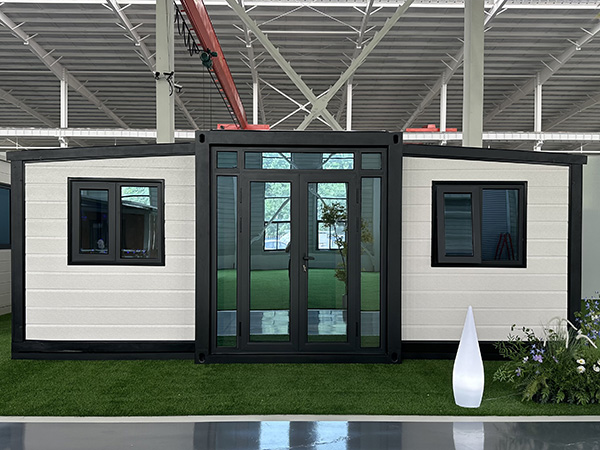
Folding houses are designed for fast, tool-simple on-site installation (typically completed by 2–3 people in 30 mins to a few hours, depending on the size) with no need for professional construction teams or heavy hoisting equipment. The installation process follows a logical, step-by-step workflow centered on site preparation, structural unfolding, locking fixation, and functional finishing—all reversible for future relocation. Below is the standard on-site installation process for most folding house models:
1. Pre-Installation: Site Preparation & Unpacking
Site leveling & cleaning: Clear the installation area of debris, stones, and uneven ground; ensure the site is flat (a slope of ≤3° is acceptable for most models). Lay simple cushioning materials (e.g., steel plates, wooden planks, cement floor tiles, or gravel pads) on the ground to prevent the house frame from direct contact with wet/muddy soil, enhancing stability and waterproofing of the base.
Unpack & inspect: Unload the folded house unit from the transport vehicle (via manual handling or small trolleys) and place it at the pre-marked installation position. Check all components for damage: confirm the load-bearing frame, hinges, telescopic braces, and locking mechanisms are intact; verify that wall/roof/floor panels, sealing strips, and small accessories (screws, lubricant) are complete.
2. Core Step: Structural Unfolding & Primary Support
Initiate folding release: Unlock the external fixed straps/buckles of the folded house unit (the main anti-loosening device for transportation) and open the primary folding latches connecting the frame and panels.
Unfold the main structure: Cooperate with 2–3 people to slowly pull/push the foldable wall, roof, and floor panels along the hinged rotation direction (most models unfold in a "side-to-side" or "up-and-down" manner). For units with scissor-type telescopic braces, the braces will automatically stretch as the frame unfolds, forming the initial triangular/square support system to prevent the structure from tilting.
Extend auxiliary supports: For medium/large folding houses, pull out the retractable support legs (at the bottom of the frame) and adjust their height to keep the entire house level; lock the support legs in place to reinforce the base stability.
3. Key Step: Full Locking & Structural Reinforcement
This step converts the "movable foldable structure" into a rigid fixed structure and is critical for wind/load resistance.
Lock hinge joints: Secure all major hinged connections (between walls, roof and walls, floor and walls) with built-in spring snap locks or manual bolt fasteners to prevent accidental rotation of panels.
Fix telescopic braces: Lock the scissor-type telescopic braces at their fully stretched position (most have self-locking clamps) to ensure they bear the lateral and vertical loads of the house.
Seal the joints: Attach the pre-equipped rubber sealing strips to the gaps between panels (wall-wall, wall-roof, wall-floor) to enhance waterproofing and windproofing; press the strips tightly to avoid air/water leakage.
4. Finishing Step: Functional Assembly & Inspection
Basic fitting connection: Connect the pre-installed internal functional components (e.g., lighting sockets, ventilation fans, basic wiring) to an external power source (if needed); install simple accessories such as door handles, window latches, and internal partition boards (if customized).
On-site integrity inspection:
Check the overall structure for levelness and no obvious tilting; shake the frame slightly to confirm no loose locks or wobbly supports.
Test the doors and windows to ensure they open/close smoothly and seal tightly.
Check the sealing gaps for no obvious cracks; conduct a simple water test (e.g., sprinkling water on the roof) if conditions permit to verify waterproofing.
Test the electrical components (if equipped) to ensure normal operation and no safety hazards.
5. Post-Installation: Simple Adjustment (If Needed)
If the ground has minor unevenness, fine-tune the height of the support legs to keep the house stable.
Trim any excess sealing strips and clean the internal/external surfaces of the house to remove packaging debris and dust.
Key Notes for Installation
Operation safety: Avoid violent pulling/pushing during unfolding to prevent damage to hinges or panels; ensure all locks are fully engaged before use (do not use the house with loose locks).
Weather conditions: It is recommended to install in calm, dry weather; avoid installation in heavy rain, strong wind (≥6 winds), or snow to prevent structural instability during operation.
Tool simplicity: Most installations only require basic hand tools (e.g., a screwdriver, wrench) for minor adjustments—no power tools or heavy equipment are needed for standard models.
Reverse Operation for Relocation
The installation process is fully reversible: when relocating, simply disconnect the power supply → remove sealing strips → unlock all fasteners/braces → fold the frame and panels in reverse order → lock the transport straps → pack and load. This reversibility ensures the house can be relocated repeatedly without structural damage.
References
GB/T 7714:YETKİN İ, MADEN F, TOSUN S, et al. A foldable temporary shelter design[C]//Proceedings of IASS Annual Symposia. International Association for Shell and Spatial Structures (IASS), 2024, 2024(12): 1-7.
MLA:YETKİN, İrem, et al. "A foldable temporary shelter design." Proceedings of IASS Annual Symposia. Vol. 2024. No. 12. International Association for Shell and Spatial Structures (IASS), 2024.
APA:YETKİN, İ., MADEN, F., TOSUN, S., KİLİT, Ö., AKGÜN, Y., KİPER, G., ... & GÜNDÜZALP, M. (2024, August). A foldable temporary shelter design. In Proceedings of IASS Annual Symposia (Vol. 2024, No. 12, pp. 1-7). International Association for Shell and Spatial Structures (IASS).