




What are the differences between expandable container houses and regular container houses?
2026-02-05 04:16:10
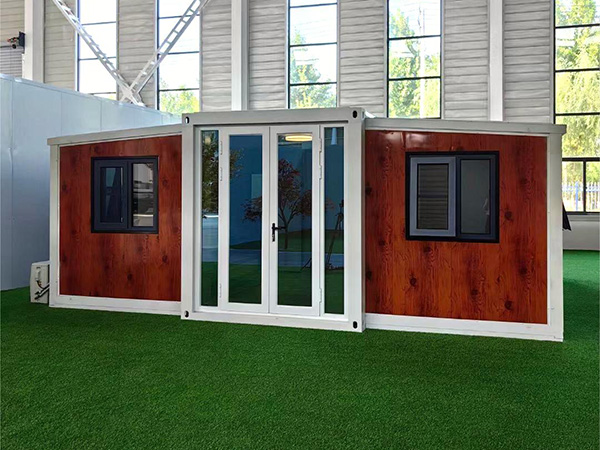
What are the differences between expandable container houses and regular container houses?
The core difference lies in their space flexibility. Regular containers have a fixed structure, emphasizing standardization and low cost, while expandable containers have a retractable structure, combining the portability of containers with a larger space. Key differences are as follows:
Space Utilization:** Regular containers have fixed dimensions, approximately 14-16 square meters within a 20-foot container; expandable containers fold up to a standard container, increasing space by 1.5-3 times when unfolded (30-40 square meters within a 20-foot container), and can be extended on one or both sides.*Installation and Operation:** Regular containers are ready to use immediately upon arrival, requiring 1-2 people and 1-2 hours to complete; expandable containers require on-site hydraulic/manual unfolding, requiring 2-4 people and 15-60 minutes to complete, and require reserved space for expansion.
Transportation and Storage:** Both are transported using standard containers; however, expandable containers can be folded and stacked for storage, significantly saving storage space. For bulk transport, the usable area per vehicle is much higher than that of regular containers.
Structure and Maintenance: The standard model features integral welding with no moving parts, ensuring stable sealing and simple, zero-cost maintenance. The expandable model includes a telescopic frame/hydraulic system, has seams requiring sealing strips, and necessitates regular maintenance of the guide rails and hydraulic components, as well as seal replacement.
Cost and Adaptability: The standard model is 30%-50% cheaper and suitable for long-term, fixed, standardized scenarios (construction site dormitories, fixed warehouses). The expandable model is more expensive and suitable for scenarios with large space requirements and flexible relocation/recycling needs (emergency housing, temporary commercial spaces, remote settlements).
Configuration and Performance: The standard model has a basic configuration and is highly adaptable. The expandable model is often factory-integrated with high-end features (pre-installed water, electricity, and bathroom fixtures), ready to use upon unfolding, offering superior insulation and soundproofing, but with slightly lower rigidity than the standard model.
References
GB/T 7714:Šljivić A, Salihbegović A, Miljanović S. Container architecture in the context of sustainable construction of residential facilities in Bosnia and Herzegovina[J]. International Journal of Advanced Research, 2021, 9(01): 743-753.
MLA:Šljivić, A., A. Salihbegović, and S. Miljanović. "Container architecture in the context of sustainable construction of residential facilities in Bosnia and Herzegovina." International Journal of Advanced Research 9.01 (2021): 743-753.
APA:Šljivić, A., Salihbegović, A., & Miljanović, S. (2021). Container architecture in the context of sustainable construction of residential facilities in Bosnia and Herzegovina. International Journal of Advanced Research, 9(01), 743-753.