




How do Foldable Packing Container achieve rapid folding and unfolding?
2025-12-29 10:26:52
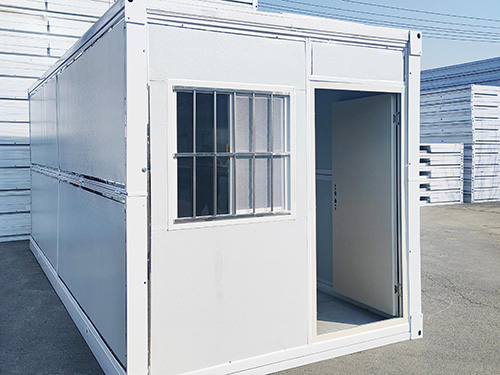
How do Foldable Packing Container achieve rapid folding and unfolding?
The core of rapid folding and unfolding in Foldable Packing Container lies in their modular frame design, linked folding structure, and standardized connectors. The entire process requires no complex tools and can be completed quickly by one or two people. The specific implementation methods and steps are as follows:
I. Core Structural Design (The Foundation of Rapid Folding)
The structure of the Foldable Packing Container is designed around "reducing disassembly steps and achieving component linkage." Key components include:
Folding Steel Frame: The main frame of the box uses a segmented steel structure connected by hinges. The top and bottom frames are connected by foldable uprights. High-strength hinges are built into the connections between the uprights and the frame, allowing for 90° or 180° folding.
The side walls and top/bottom panels often employ nested or spliced designs to avoid disassembling individual components. When folded, they can be directly fitted against the frame for storage.
Linked Wall Panels/Top Panels: The side walls are divided into fixed and folding sides. The fixed side is welded to the main frame, while the folding side is connected to the fixed side via hinges. When folded, it can fold inward to fit the fixed side, reducing space occupation.
The top and bottom panels mostly adopt a flip-up or sliding structure. When folded, the top panel can fold downward to cover the side walls, while the bottom panel retracts in conjunction with the bottom frame.
Standardized Quick Connectors: Traditional bolts and nuts are abandoned in favor of snap-fit, pin-type, or locking connectors. For example, spring pins are used to secure the frame joints, and push-button snaps are used to connect the wall panels to the frame. No wrenches or other tools are needed; locking and unlocking can be done manually.
II. Quick Folding Steps (Taking a common double-fold packing box as an example):
Preparation: Empty the contents of the box, close and lock the doors and windows, and check that all connectors are unlocked.
Side Wall Folding: Unfasten the latches between the side walls and the frame. Fold the side panels inwards, attaching them to the fixed wall panels inside the box. Utilize the hinges during folding to prevent parts from jamming.
Upright and Frame Folding: Unlock the connecting pins between the top frame and the uprights. Flip the uprights downwards, allowing the top and bottom frames to gradually fold together. Some designs allow the top frame to be pressed directly downwards, using gravity to complete the folding.
Storage and Securing: After folding, secure the entire frame with straps or buckles to prevent it from unraveling during transport. At this point, the box volume can be reduced to 1/3 to 1/5 of its unfolded state.
III. Quick Unfolding Steps: Unlocking and Securing: Remove the straps and buckles, and lay the folded frame flat on a level surface.
Frame Unfolding: Lift the top frame upwards. The uprights will automatically unfold with the hinges and become perpendicular to the ground. Once in place, insert the spring pins to lock the uprights and the upper and lower frames in position, ensuring the frame is square and stable.
Wall Panel Unfolding and Fixing: Pull the folded side walls outwards and snap them into the pre-set buckle positions on the frame. Press to lock, ensuring no gaps between the wall panels.
Detailed Inspection: Check that doors and windows open smoothly and that all connectors are securely locked. Once the container structure is confirmed to be stable, it is ready for use.
IV. Auxiliary Designs to Improve Folding/Unfolding Efficiency:
Lightweight Materials: The frame uses high-strength lightweight steel, and the wall panels use polystyrene sandwich panels or rock wool sandwich panels, reducing component weight and facilitating manual operation.
Roller Assistance: Some large Foldable Packing Container are equipped with casters at the bottom, allowing for direct pushing and pulling to adjust the position during unfolding without the need for a crane.
Pre-assembly Process: Doors, windows, electrical circuits, and other components are pre-installed before leaving the factory, eliminating the need for repeated disassembly during folding/unfolding and further saving time.
The advantage of this design is that it does not require a professional construction team, making it suitable for scenarios requiring rapid deployment and relocation, such as temporary offices, construction site dormitories, and emergency shelters.
References
GB/T 7714:Verzoni A, Rais-Rohani M. Transition analysis of flat-foldable origami-inspired deployable shelter concepts[J]. Engineering Structures, 2022, 273: 115074.
MLA:Verzoni, Anthony, and Masoud Rais-Rohani. "Transition analysis of flat-foldable origami-inspired deployable shelter concepts." Engineering Structures 273 (2022): 115074.
APA:Verzoni, A., & Rais-Rohani, M. (2022). Transition analysis of flat-foldable origami-inspired deployable shelter concepts. Engineering Structures, 273, 115074.